Strategies of Communication on Climate Change
Showing posts with label memes. Show all posts

Friday, January 17, 2014

The unsustainable dullness of common sense


Jo Abbess correactly aims against the dullness of people who continue repeating the same silly memes about renewable energy and climate change. (image above)

Curmudgeons Happen

by Jo Abbess

I was talking with people at my friend’s big birthday bash yesterday. I mentioned I’m writing about Renewable Gas, and this led to a variety of conversations. Here is a kind of summary of one of the threads, involving several people.

Why do people continue to insist that the wind turbine at Reading uses more energy than it generates ?

Would it still be there if it wasn’t producing power? Does David Cameron still have a wind turbine on his roof? No. It wasn’t working, so it was taken down. I would ask – what are their sources of information? What newspapers and websites do they read?

They say that the wind turbine at Reading is just there for show.

Ah. The “Potemkin Village” meme – an idyllic-looking setting, but everything’s faked. The Chinese painting the desert green, etc.

And then there are people that say that the only reason wind farms continue to make money is because they run the turbines inefficiently to get the subsidies.

Ah. The “De-rating Machine” meme. You want to compare and contrast. Look at the amount of money, resources, time and tax breaks being poured into the UK Continental Shelf, and Shale Gas, by the current Government.

Every new technology needs a kick start, a leg up. You need to read some of the reports on wind power as an asset – for example, the Offshore Valuation – showing a Net Present Value. After it’s all deployed, even with the costs of re-powering at the end of turbine life, offshore North Sea wind power will be a genuine asset.

What I don’t understand is, why do people continue to complain that wind turbines spoil the view? Look at the arguments about the Jurassic Coast in Dorset.

I have contacts there who forward me emails about the disputes. The yachtsmen of Poole are in open rebellion because the wind turbines will be set in in their channels ! The tourists will still come though, and that’s what really counts. People in Dorset just appear to love arguing, and you’ve got some people doing good impressions of curmudgeons at the head of the branches of the Campaign for the Protection of Rural England (CPRE) and English Heritage.

There are so many people who resist renewable energy, and refuse to accept we need to act on climate change. Why do they need to be so contrarian? I meet them all the time.

People don’t like change, but change happens. The majority of people accept that climate change is significant enough to act on, and the majority of people want renewable energy. It may not seem like that though. It depends on who you talk with. There’s a small number of people who vocalise scepticism and who have a disproportionate effect. I expect you are talking about people who are aged 55 and above?

Example : “Climate Change ? Haw haw haw!” and “Wind turbines? They don’t work!” This is a cohort problem. All the nasty white racists are dying and being buried with respect by black undertakers. All the rabid xenophobes are in nursing homes being cared for in dignity by “foreigners”. Pretty soon Nigel Lawson could suffer from vascular dementia and be unable to appear on television.

Continue reading on Jo Abbess's blog

Friday, July 19, 2013

What's in a meme? Why climate change doesn't go viral


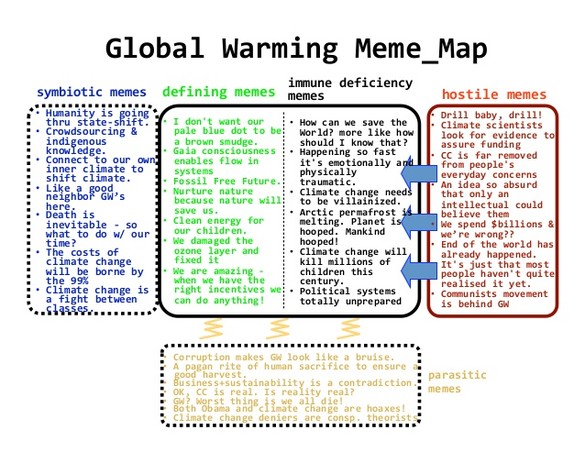
A "meme map" of climate change as proposed by Lazlo Karafiath and Joe Brewer


Memes are ideas that survive and multiply in the human mind. They spread, they diffuse, they affect everyone. Memes are the basis of what we often call today "viral" communication, but which has been the normal way of communicating of human beings for millennia. Some memes are good - in the sense that they correspond to reality - others are bad for the opposite reason - they are delusionary memes; they form the body of the legends and myths that pervade the Internet nowadays - from chemtrails to fake Moon landings.

When we deal with climate change, unfortunately, "bad" memes seem to be much more common than good ones. There is a long, long list of false and extremely common memes: the earth is not warming any more, Greenland was ice free during the Middle Ages, scientists have altered the data..... You can find a list of 174 (!!) of these bad memes at "Skeptical Science." The mind of some people seems to be infested with these bad climate memes - such as the one of the British secretary of state for the environment.

So, why all those delusionary memens on climate? Maybe, we simply didn't work enough at finding "good" memes that spread. Maybe, if we were clever enough, we could put together  a viral communication system that would spread the correct message about climate change. That was the idea put forward by Lazlo Karafiath and Joe Brewer, co-founders of DarwinSF. They have been trying to find these good memes. The results have been interesting, but so far we still don't have the magic meme on climate change.

But why exactly do bad memes spread so much more easily than good ones? A recent study from UCLA researchers gives us an interesting explanation. The study has to do with a region of the brain called the temporoparietal junction, or TPJ, but, in the end, the whole story reduces to what they call "mentalism"; people attempting to read other people's minds and act accordingly. .

"You might expect people to be most enthusiastic and opinionated about ideas that they themselves are excited about, but our research suggests that's not the whole story. Thinking about what appeals to others may be even more important."

You see? It is simple! People will spread a meme if they think that their circle of friends and acquaintances will like it. There is nothing especially important in the meme itself - it may be quite stupid and dealing with absolutely vague and remote entities. Think of the one that says "Pluto is warming and hence global warming is caused by the sun". Most people probably, have only a vague idea of what and where Pluto is and what its warming could mean. Nevertheless this meme spreads, just as others of the same kind do. Why is that? Well, simply because these memes carry a soothing message. They say, "See? Those pompous scientists got everything wrong. There is nothing to be worried about and, in any case, it is not our fault."

Now, you can share this kind of memes with your friends and acquaintances without worrying about upsetting them. After all, everybody likes poking fun at pompous people, such as scientists are. It is almost as much fun as sharing pictures of cute kittens. Surely, not the same as sending to your friends a message about climate change that says, basically, "hey, we are all going to starve and die".

To be sure, there is more in meme spreading than just the interpretation proposed by the UCLA researchers. But if they are right - and what they say makes a lot of sense - then it is useless to keep searching for the magic meme that will bring climate change back to people's attention. The message about climate change simply will not go spontaneously viral.

At least we know what the problem is. That doesn't mean it is unsolvable, but purely bottom-up communication (the kind done with blogs and social media) is not enough. We need to think also in terms of top-down communication. In other words, we need the media to inform the public about the danger we are facing. Unfortunately, they are not doing their job very well. The latest example of a long series of disaster is a recent piece by "The Economist," about which you can read at "Skeptical Science" and at "Thinkprogress."

So, how can we convince the media to do a better job? Ideas, anyone?


Monday, July 15, 2013

Global Warming has stopped: the meme that won't go away


Image from "ClimateNexus"


A remarkably effective set of data from "Climate Nexus". Warming has not stopped and, yet, the "warming has stopped" meme remains alive and well. Another illustration of the fact that rational arguments just don't stick. Most people much prefer legends. And the warming continues......


Thursday, July 4, 2013

A meme-infected mind

Image from photobucket.com


"Skeptical Science" reports a rather extraordinary statement by the British Secretary of State for the Environment, Owen Paterson. Here it is:


"Well I'm sitting like a rose between two thorns here and I have to take practical decisions - erm - the climate's always been changing - er - Peter mentioned the Arctic and I think in the Holocene the Arctic melted completely and you can see there were beaches there - when Greenland was occupied, you know, people growing crops - we then had a little ice age, we had a middle age warming - the climate's been going up and down - but the real question which I think everyone's trying to address is - is this influenced by manmade activity in recent years and James [Delingpole] is actually correct - the climate has not changed - the temperature has not changed in the last seventeen years and what I think we've got to be careful of is that there is almost certainly - bound to be - some influence by manmade activity but I think we've just got to be rational (audience laughter)  - rational people - and make sure the measures that we take to counter it don't actually cause more damage - and I think we're about to get -" 

(See here for a detailed debunking of these statements)


Doesn't this statement give you the impression of an infected mind? Something like a Petri dish full of bacteria festering on their nutrient solution.

Minds, however, are not so often infected by real bacteria or virus but are easily prey to their virtual equivalent: "memes." Originally proposed by Richard Dawkins in the 1970s, the concept of meme sees ideas as able to reproduce and spread hopping from one mind to another; it is the origin of the idea of "viral communication".

As we see from the statement from Secretary Paterson, sometimes a human mind seems to be more a battleground for infectious memes than the rational computing device that we imagine it to be.

But what is really maddening, here, is how well "negative" memes (intended as contrary to reality) spread. There exist perfectly good memes that describe how climate change is happening; for instance "the Arctic is melting" is a meme that describes reality. But, no; these memes don't spread, don't stick. So, Mr. Paterson doesn't mention that "the Arctic is melting"(true) but that "in the Holocene the Arctic melted completely" (not true).

That is confirmed by a study by Lazlo Karafiath and Joe Brewer, co-founders of DarwinSF. They found that memes that describe the reality of climate change simply don't stick. Why is that? Perhaps we didn't find the right memes; or is it that the human mind is structured in such a way to reject reality when given a chance to do so?


Hard to say; in any case we can't hope to diffuse the urgency of doing something about climate change if we don't take into account the concept of meme. For a start, you may give a look to this video - also by the founders of DarwinSF