Strategies of Communication on Climate Change
Showing posts with label debate. Show all posts

Wednesday, October 23, 2013

Why trolls are so effective in the debate


Comments can be bad for science. That's why, here at PopularScience.com, we're shutting them off.


It wasn't a decision we made lightly. As the news arm of a 141-year-old science and technology magazine, we are as committed to fostering lively, intellectual debate as we are to spreading the word of science far and wide. The problem is when trolls and spambots overwhelm the former, diminishing our ability to do the latter.

That is not to suggest that we are the only website in the world that attracts vexing commenters. Far from it. Nor is it to suggest that all, or even close to all, of our commenters are shrill, boorish specimens of the lower internet phyla. We have many delightful, thought-provoking commenters.

But even a fractious minority wields enough power to skew a reader's perception of a story, recent research suggests. In one study led by University of Wisconsin-Madison professor Dominique Brossard, 1,183 Americans read a fake blog post on nanotechnology and revealed in survey questions how they felt about the subject (are they wary of the benefits or supportive?). Then, through a randomly assigned condition, they read either epithet- and insult-laden comments ("If you don't see the benefits of using nanotechnology in these kinds of products, you're an idiot" ) or civil comments.

The results, as Brossard and coauthor Dietram A. Scheufele wrote in a New York Times op-ed:

Uncivil comments not only polarized readers, but they often changed a participant's interpretation of the news story itself.
In the civil group, those who initially did or did not support the technology — whom we identified with preliminary survey questions — continued to feel the same way after reading the comments. Those exposed to rude comments, however, ended up with a much more polarized understanding of the risks connected with the technology.
Simply including an ad hominem attack in a reader comment was enough to make study participants think the downside of the reported technology was greater than they'd previously thought.

Another, similarly designed study found that just firmly worded (but not uncivil) disagreements between commenters impacted readers' perception of science.

If you carry out those results to their logical end--commenters shape public opinion; public opinion shapes public policy; public policy shapes how and whether and what research gets funded--you start to see why we feel compelled to hit the "off" switch.
Even a fractious minority wields enough power to skew a reader's perception of a story.

A politically motivated, decades-long war on expertise has eroded the popular consensus on a wide variety of scientifically validated topics. Everything, from evolution to the origins of climate change, is mistakenly up for grabs again. Scientific certainty is just another thing for two people to "debate" on television. And because comments sections tend to be a grotesque reflection of the media culture surrounding them, the cynical work of undermining bedrock scientific doctrine is now being done beneath our own stories, within a website devoted to championing science.

There are plenty of other ways to talk back to us, and to each other: through Twitter, Facebook, Google+, Pinterest, livechats, email, and more. We also plan to open the comments section on select articles that lend themselves to vigorous and intelligent discussion. We hope you'll chime in with your brightest thoughts. Don't do it for us. Do it for science.

Suzanne LaBarre is the online content director of Popular Science. Email suzanne.labarre at popsci dot com.



Friday, July 19, 2013

What's in a meme? Why climate change doesn't go viral


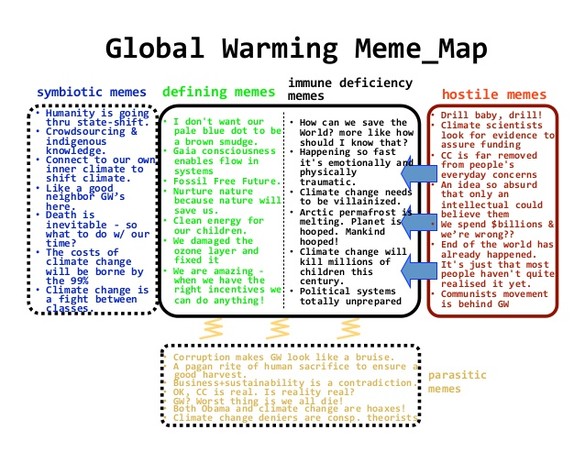
A "meme map" of climate change as proposed by Lazlo Karafiath and Joe Brewer


Memes are ideas that survive and multiply in the human mind. They spread, they diffuse, they affect everyone. Memes are the basis of what we often call today "viral" communication, but which has been the normal way of communicating of human beings for millennia. Some memes are good - in the sense that they correspond to reality - others are bad for the opposite reason - they are delusionary memes; they form the body of the legends and myths that pervade the Internet nowadays - from chemtrails to fake Moon landings.

When we deal with climate change, unfortunately, "bad" memes seem to be much more common than good ones. There is a long, long list of false and extremely common memes: the earth is not warming any more, Greenland was ice free during the Middle Ages, scientists have altered the data..... You can find a list of 174 (!!) of these bad memes at "Skeptical Science." The mind of some people seems to be infested with these bad climate memes - such as the one of the British secretary of state for the environment.

So, why all those delusionary memens on climate? Maybe, we simply didn't work enough at finding "good" memes that spread. Maybe, if we were clever enough, we could put together  a viral communication system that would spread the correct message about climate change. That was the idea put forward by Lazlo Karafiath and Joe Brewer, co-founders of DarwinSF. They have been trying to find these good memes. The results have been interesting, but so far we still don't have the magic meme on climate change.

But why exactly do bad memes spread so much more easily than good ones? A recent study from UCLA researchers gives us an interesting explanation. The study has to do with a region of the brain called the temporoparietal junction, or TPJ, but, in the end, the whole story reduces to what they call "mentalism"; people attempting to read other people's minds and act accordingly. .

"You might expect people to be most enthusiastic and opinionated about ideas that they themselves are excited about, but our research suggests that's not the whole story. Thinking about what appeals to others may be even more important."

You see? It is simple! People will spread a meme if they think that their circle of friends and acquaintances will like it. There is nothing especially important in the meme itself - it may be quite stupid and dealing with absolutely vague and remote entities. Think of the one that says "Pluto is warming and hence global warming is caused by the sun". Most people probably, have only a vague idea of what and where Pluto is and what its warming could mean. Nevertheless this meme spreads, just as others of the same kind do. Why is that? Well, simply because these memes carry a soothing message. They say, "See? Those pompous scientists got everything wrong. There is nothing to be worried about and, in any case, it is not our fault."

Now, you can share this kind of memes with your friends and acquaintances without worrying about upsetting them. After all, everybody likes poking fun at pompous people, such as scientists are. It is almost as much fun as sharing pictures of cute kittens. Surely, not the same as sending to your friends a message about climate change that says, basically, "hey, we are all going to starve and die".

To be sure, there is more in meme spreading than just the interpretation proposed by the UCLA researchers. But if they are right - and what they say makes a lot of sense - then it is useless to keep searching for the magic meme that will bring climate change back to people's attention. The message about climate change simply will not go spontaneously viral.

At least we know what the problem is. That doesn't mean it is unsolvable, but purely bottom-up communication (the kind done with blogs and social media) is not enough. We need to think also in terms of top-down communication. In other words, we need the media to inform the public about the danger we are facing. Unfortunately, they are not doing their job very well. The latest example of a long series of disaster is a recent piece by "The Economist," about which you can read at "Skeptical Science" and at "Thinkprogress."

So, how can we convince the media to do a better job? Ideas, anyone?