
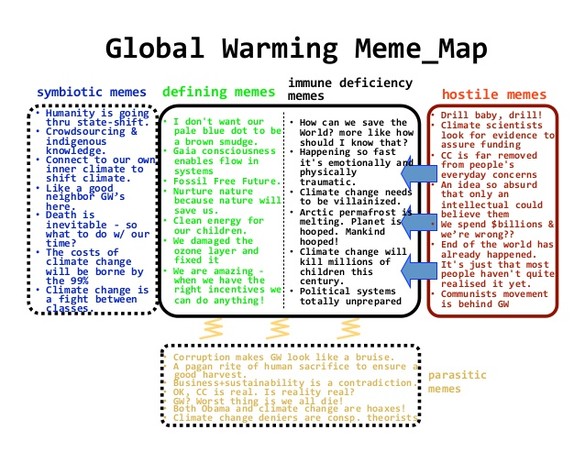
A "meme map" of climate change as proposed by Lazlo Karafiath and Joe Brewer
Memes are ideas that survive and multiply in the human mind. They spread, they diffuse, they affect everyone. Memes are the basis of what we often call today "viral" communication, but which has been the normal way of communicating of human beings for millennia. Some memes are good - in the sense that they correspond to reality - others are bad for the opposite reason - they are delusionary memes; they form the body of the legends and myths that pervade the Internet nowadays - from chemtrails to fake Moon landings.
When we deal with climate change, unfortunately, "bad" memes seem to be much more common than good ones. There is a long, long list of false and extremely common memes: the earth is not warming any more, Greenland was ice free during the Middle Ages, scientists have altered the data..... You can find a list of 174 (!!) of these bad memes at "Skeptical Science." The mind of some people seems to be infested with these bad climate memes - such as the one of the British secretary of state for the environment.
So, why all those delusionary memens on climate? Maybe, we simply didn't work enough at finding "good" memes that spread. Maybe, if we were clever enough, we could put together a viral communication system that would spread the correct message about climate change. That was the idea put forward by Lazlo Karafiath and Joe Brewer, co-founders of DarwinSF. They have been trying to find these good memes. The results have been interesting, but so far we still don't have the magic meme on climate change.
But why exactly do bad memes spread so much more easily than good ones? A recent study from UCLA researchers gives us an interesting explanation. The study has to do with a region of the brain called the temporoparietal junction, or TPJ, but, in the end, the whole story reduces to what they call "mentalism"; people attempting to read other people's minds and act accordingly. .
"You might expect people to be most enthusiastic and opinionated about ideas that they themselves are excited about, but our research suggests that's not the whole story. Thinking about what appeals to others may be even more important."
You see? It is simple! People will spread a meme if they think that their circle of friends and acquaintances will like it. There is nothing especially important in the meme itself - it may be quite stupid and dealing with absolutely vague and remote entities. Think of the one that says "Pluto is warming and hence global warming is caused by the sun". Most people probably, have only a vague idea of what and where Pluto is and what its warming could mean. Nevertheless this meme spreads, just as others of the same kind do. Why is that? Well, simply because these memes carry a soothing message. They say, "See? Those pompous scientists got everything wrong. There is nothing to be worried about and, in any case, it is not our fault."
Now, you can share this kind of memes with your friends and acquaintances without worrying about upsetting them. After all, everybody likes poking fun at pompous people, such as scientists are. It is almost as much fun as sharing pictures of cute kittens. Surely, not the same as sending to your friends a message about climate change that says, basically, "hey, we are all going to starve and die".
To be sure, there is more in meme spreading than just the interpretation proposed by the UCLA researchers. But if they are right - and what they say makes a lot of sense - then it is useless to keep searching for the magic meme that will bring climate change back to people's attention. The message about climate change simply will not go spontaneously viral.
At least we know what the problem is. That doesn't mean it is unsolvable, but purely bottom-up communication (the kind done with blogs and social media) is not enough. We need to think also in terms of top-down communication. In other words, we need the media to inform the public about the danger we are facing. Unfortunately, they are not doing their job very well. The latest example of a long series of disaster is a recent piece by "The Economist," about which you can read at "Skeptical Science" and at "Thinkprogress."
So, how can we convince the media to do a better job? Ideas, anyone?
